

Play a puzzle
at your pace.
Fit blocks, untangle lines, or find shapes. Clear goals and fresh puzzles give your hands and mind something to do.
Choose a game CopeWellFrom AddictionHelp.com
Satisfying games and practical tools for stress, urges, and everyday breaks.
No timer. Instructions as you play. This concept preview requires no payment or download.
A game is a place to start. When you want to work through a thought or plan a next step, there are seven guided activities to explore.
Fit blocks, untangle lines, or find shapes. Clear goals and fresh puzzles give your hands and mind something to do.
Choose a gameSort facts from guesses, try another perspective, or put a feeling into words. Use a fictional example or your own words.
Explore coping activitiesWrite about what’s happening and what you want to do next. Start with a few words or use a short prompt.
Open your journalFour games to try today. Play at your pace, without a countdown.
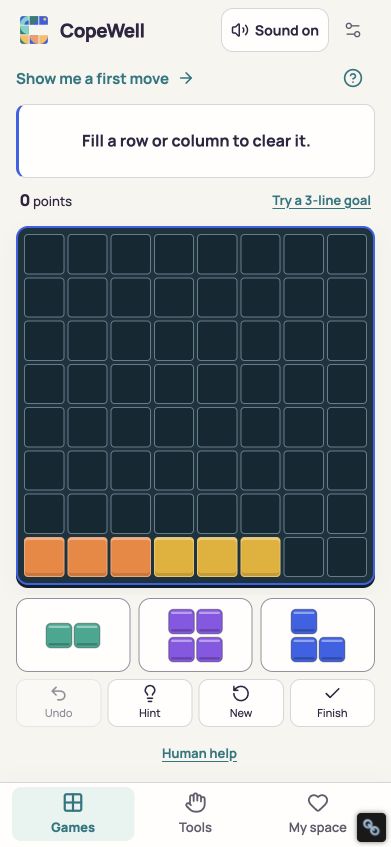
Fit the pieces on the board. Fill a row or column to clear it and make room for your next move.
Free play or a three-line goal. Optional points and collection.
Play BlocksMove the dots until the lines no longer cross. Start small or choose more dots for a bigger puzzle.
Three puzzle sizes. Guided hints when you want a hand.
Play One ThreadFind matching shapes, count them, or add up their corners. Shape and rotation keep each new scene different.
Choose a small, medium, or large board.
Play NoticeRotate colorful tiles to match a mosaic. Watch a pattern come together, one turn at a time.
Three sizes. Compare, rotate, and undo any turn.
Make a PatternYou don’t need a diagnosis or a difficult day to enjoy a game.
Fit a piece, turn a tile, or find a shape. Pick a challenge that holds your attention without a countdown.
Find your gameUse a game as a pause alongside the people, routines, and support that matter in your recovery.
Read the games researchSort a thought, draft a request, or rehearse a small plan. Try a fictional example or use your own words.
Explore the activitiesThere’s a lot going on today.
I don’t have to sort it all out.
Next, I’ll make some tea.
An example note. Your words are your own.
A journal gives you a place to put what’s on your mind. There’s no score, no right answer, and no need to share it.
We created CopeWell at AddictionHelp.com to give you something useful to reach for during stress, urges, or boredom.
Coping takes practice. We want that practice to feel enjoyable and fit into daily life, with activities you can return to and leave when you’re ready.
Why we chose these activitiesNo. You can play because you enjoy puzzles, take a quiet break, or jot down a thought. You don’t need a diagnosis or a reason to use it.
Tap Play Blocks on Home to start, or Continue Blocks to return to your board. Activities holds all the games and guided exercises. My space keeps your journal, favorite, saved next step, and sound and display preferences.
The iPhone app is still in development and isn’t on the App Store yet. You can use this free browser preview on your phone now.
CopeWell offers games, noticing exercises, and a journal for everyday coping. It is not therapy or addiction treatment. Read the wellbeing disclaimer.
Your notes stay in this browser on this device. They aren’t sent to us or analyzed by AI. But someone who can open your device or browser may be able to read them: there is no separate journal lock or app-level encryption. Read the privacy details.
Yes. The app has controls for sound, motion, and evening colors. This website has its own motion switch at the bottom of each page and follows your device’s reduced-motion setting.
Your game progress and journal save on this device. There is no daily streak to lose. Return in the same browser to pick up where you left off. Clearing site data can erase your saves.
Start with a puzzle. Explore the coping activities when you want to.